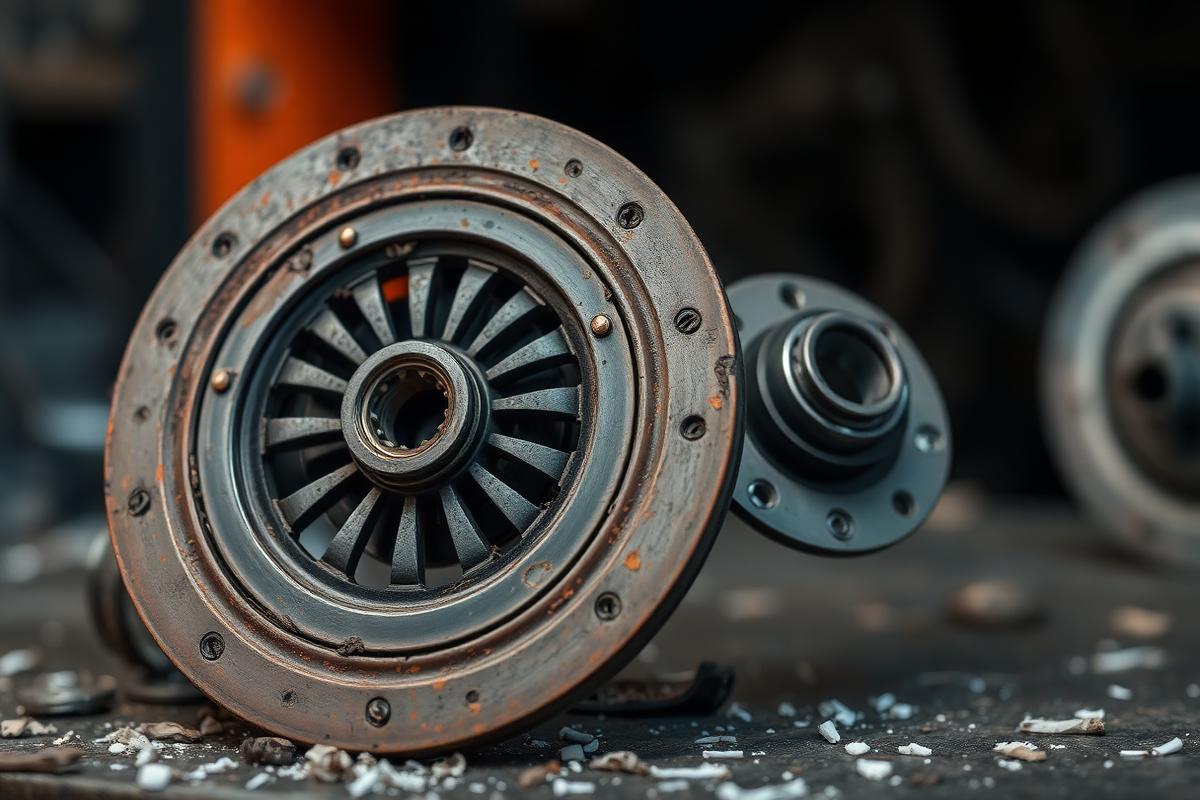
Land Rovers are heavy, torquey and often asked to tow. That's a hard life for a dual mass flywheel. When one starts to fail on a manual Evoque or Discovery Sport, the repair is a bigger job than on a family hatchback, so it matters even more that the diagnosis is right before money is spent.
We see a lot of these cars from the south side of our patch — Wilmslow, Alderley Edge, Bramhall, Hale and Altrincham all have plenty of them — as well as working Defenders from farms and trades around the Pennine edge.
Manual or automatic? Check this first
Not every Land Rover has a clutch flywheel to replace. The full-size Range Rover, the Range Rover Sport, the Velar and the Discovery 4 and 5 are almost always automatics. They use a torque converter, not a clutch and dual mass flywheel. Many later Evoques and Discovery Sports are automatic too.
The manual cars we do DMF work on are mainly:
- Range Rover Evoque manual diesels (2.2 and later 2.0 diesel).
- Discovery Sport manual diesels.
- Freelander 2 manual diesels.
- Defender (the older Td5 and 2.2/2.4 TDCi models).
If your Land Rover is an automatic and shudders at steady speed, it's more likely the torque converter — see our torque converter replacement page. Wider automatic faults are covered on our automatic transmission replacement page. We replace automatics with tested units; we don't rebuild them.
Why these flywheels wear
A dual mass flywheel uses springs between two heavy plates to soak up the pulses of a diesel engine at low revs. On a two-tonne 4x4, every pull-away asks a lot of those springs. Add towing a caravan or horsebox, steep lanes out towards Macclesfield Forest or Saddleworth, and stop-start school runs, and the springs wear faster than they would on a lighter car.
Symptoms to listen and feel for
- Clatter at idle that quietens when the clutch pedal goes down.
- Judder pulling away, especially uphill, loaded or towing.
- Vibration through the pedal, floor or steering at low revs in a high gear.
- A heavy clunk on start-up or switch-off.
Some of these overlap with a worn clutch. Rising revs without more speed points to a slipping clutch — our clutch slipping guide helps tell the two apart.
Measured, not assumed
With the gearbox out, we measure the flywheel's free play, the rock at its centre bearing and the state of the friction face, and compare them with the figures for your engine. We photograph the readings and show you. If it's within limits, it goes back in. The same approach runs across all our flywheel work, set out on our main dual mass flywheel replacement page.
On four-wheel-drive models, getting the gearbox out means working around the transfer box and driveline. We tell you what that involves before we start, not after.
Parts and fitting
We fit OE or quality OE-equivalent flywheels and always fit a new clutch kit and release bearing at the same time. On these cars the labour is a big part of the bill, so doing the job once is the cheapest way over the life of the vehicle. We'll also tell you about anything else we see while the gearbox is out, such as a weeping seal.
What it costs
Land Rover flywheel jobs cost more than our hatchback work: the parts are dearer and the labour is longer, especially on four-wheel-drive models. The spread between models and engines is wide, so we don't publish a single figure we can't stand behind. You get a free assessment and a fixed, written price once we know the exact car. Our clutch replacement cost guide explains what moves the price on any vehicle.
Most jobs take one to two working days depending on parts. Every job carries our 12-month parts and labour guarantee.
Land Rover owners across the North West
We look after Land Rover and Range Rover drivers across Manchester, Salford, Oldham, Stockport, Trafford, Tameside, Rochdale, Bury, Bolton, with many coming up from Cheshire — see our Macclesfield, Wilmslow and Poynton and Stockport pages for getting to us. If the fault turns out to be inside the gearbox, we cover that through our gearbox assessment service. Send us your registration for a free assessment.