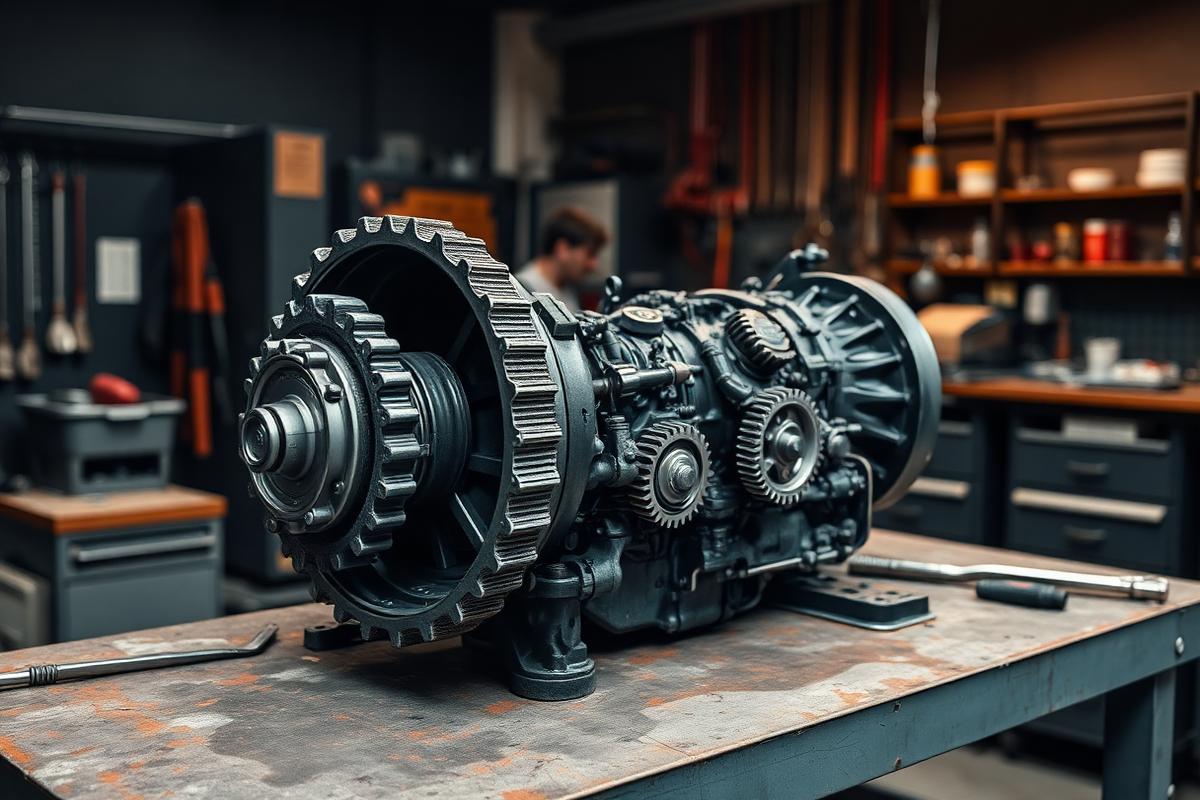
A continuously variable transmission, or CVT, does away with fixed gear ratios altogether, using a belt or chain running between two variable-diameter pulleys to give a smooth, stepless change in ratio. Done well it feels seamless. When the belt, chain, pulleys or fluid start to wear, it feels loose, rubbery, or shudders under load — and those symptoms tend to appear gradually rather than as a sudden fault.
Manchester Clutch Specialist diagnoses and replaces CVT transmissions from a wide range of manufacturers. We do not rebuild CVT units — belt and pulley wear is rarely economical to repair piecemeal — but we do check fluid condition, valve body function and sensor readings first, because not every CVT fault needs a full replacement.
CVT designs we work on
- Audi Multitronic. Uses a wide steel push-link chain and a multi-plate clutch pack instead of a torque converter, fitted mainly to larger Audi models. Known wear points are the multi-plate clutch and chain tensioner.
- Subaru Lineartronic. A pushbelt CVT fitted across most modern Subaru models, often paired with a torque converter for smoother launch. Belt and pulley wear are the main long-term concerns.
- Toyota, Honda and Nissan CVTs. Widely fitted across mainstream models, generally using a steel pushbelt or chain. Nissan's early CVTs in particular built a reputation for premature failure, largely linked to fluid condition and overheating.
Symptoms of a failing CVT
- Judder or shudder under acceleration. Belt or chain slip against the pulleys, or fluid that has lost its friction properties.
- A rubber-band feeling. Engine revs rise noticeably ahead of road speed, more pronounced than normal CVT characteristics.
- Whining or humming that changes with speed. Often points to pulley or bearing wear rather than the belt itself.
- Overheating or a burnt fluid smell. CVT fluid degrades under heat, and once it does, wear accelerates quickly.
- Hesitation or delay pulling away. Can point to valve body or clutch pack issues on Multitronic-type designs, or general pressure loss elsewhere.
- Warning light with reduced power. The transmission control unit has detected a fault and limited power to protect the unit — not a diagnosis in itself.
Some of these symptoms overlap with those covered in our gearbox whining noise guide, which is worth reading alongside this page if you are trying to narrow down the cause before booking a diagnosis.
Why fluid condition matters so much
CVT fluid is not interchangeable with conventional automatic transmission fluid. It contains specific friction modifiers that allow the belt or chain to grip the pulleys correctly without slipping, and it is formulated to cope with the constant micro-slip inherent to how a CVT works. Using the wrong fluid, or leaving the correct fluid in well past its service interval, is one of the most common causes of belt slip, judder and premature pulley wear.
We check fluid condition and level as a standard part of any CVT diagnosis, because on some vehicles a fluid and filter service resolves symptoms that look, at first glance, like they need a full transmission replacement.
Diagnosis before replacement
Because CVT symptoms overlap so heavily — judder can be fluid, belt, or pulleys, and hesitation can be a valve body or a clutch pack — we road test, read fault codes and check fluid and pressure readings before quoting anything. Where the belt or chain has damaged the pulley surfaces, repair is not realistic and we recommend transmission replacement, matched to your vehicle by chassis and transmission code.
Where the fault is contained to fluid, a sensor, or the valve body, we say so and quote accordingly. Replacing a whole transmission when a fluid service would have fixed it helps nobody.
Costs and turnaround
CVT replacement costs vary by manufacturer and by the extent of pulley damage, so we give a fixed price once diagnosis is complete rather than a generic figure. Most CVT replacement jobs are booked in for a defined number of days, agreed with you upfront, and a courtesy vehicle can usually be arranged.
CVT transmission replacement across Greater Manchester
We work on CVT-equipped vehicles from drivers across Manchester, Salford, Oldham, Stockport, Trafford, Tameside, Rochdale, Bury, Bolton and the wider North West. If your vehicle uses a dual-clutch gearbox instead, our DSG transmission replacement page covers that, and our torque converter replacement page covers conventional automatics. For anything else, our automatic transmission replacement service covers the full range. Get in touch for a diagnosis and a fixed quote.