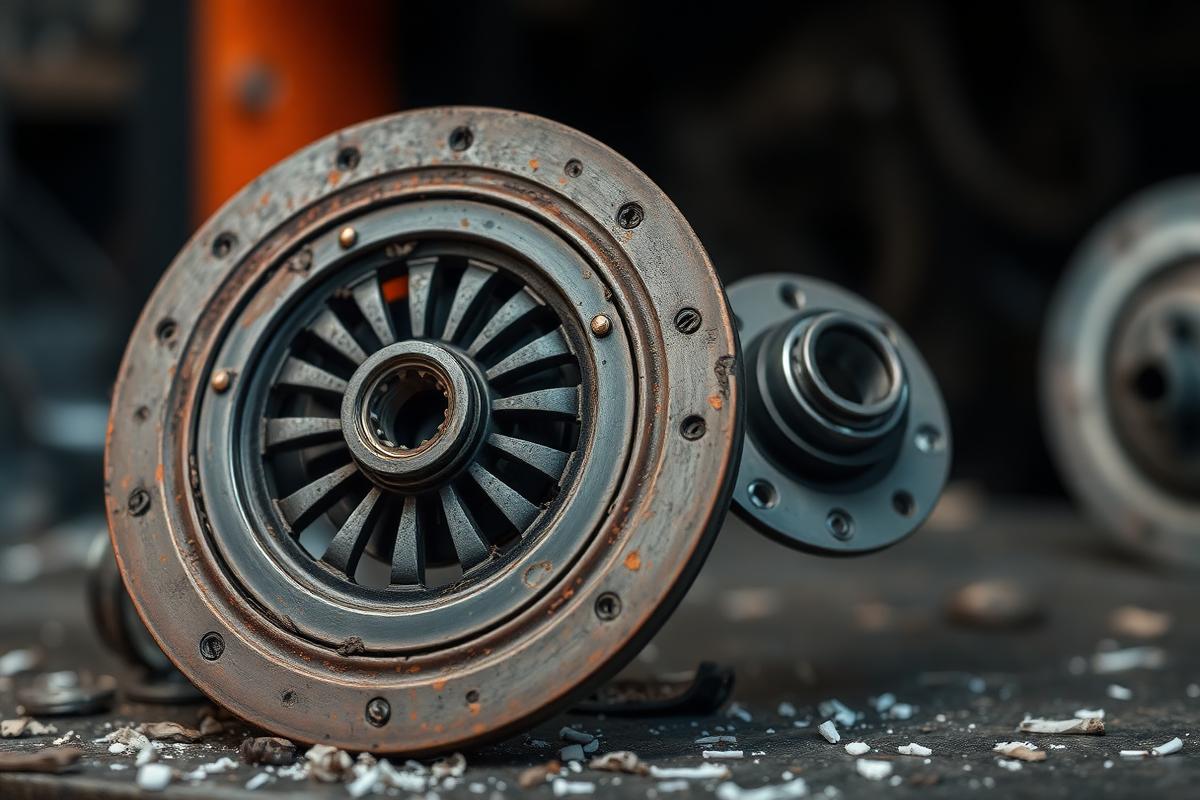
The dual mass flywheel is one of the most misunderstood components on a modern car. It's also one of the most commonly over-sold. Because it sits behind the clutch, it can only be assessed with the gearbox out — which puts the customer in the awkward position of taking a garage's word for it while their car is in pieces.
We take a different approach. Every DMF that comes out of a car in our Manchester workshop is measured against the manufacturer's published tolerances, photographed, and shown to you with the readings. If it passes, it goes back on.
What a dual mass flywheel does
A traditional solid flywheel is a single lump of machined steel bolted to the crankshaft. A dual mass flywheel splits that into two plates connected by an internal arc spring assembly and a bearing, allowing the two halves to rotate slightly independently of one another.
That movement absorbs the torsional shock produced by each combustion event. Modern diesels in particular generate enormous low-end torque in violent pulses, and without a DMF that shock passes straight into the gearbox — hence the gear rattle, boom and harshness that solid-flywheel diesels are known for. The DMF exists to make refined, high-torque, low-revving engines drivable.
The trade-off is that it contains moving, wearing parts. Springs weaken, grease degrades, the bearing wears and the permitted free play increases. Eventually it fails.
How to spot a failing DMF
DMF symptoms overlap heavily with clutch symptoms, which is exactly why proper diagnosis matters. The tell-tale signs we look for:
- Rattle at idle that changes with the clutch pedal. The single most reliable indicator. A metallic chatter at tickover in neutral that quietens or disappears when you dip the clutch strongly suggests the flywheel.
- Shudder on start-up and shutdown. A noticeable shake through the body and pedals as the engine turns over or stops.
- Vibration through the floor at low revs. Especially between roughly 1,200 and 1,800 rpm in a high gear.
- Judder pulling away that persists after a clutch has been replaced.
- A rumble or drone that rises and falls with engine speed rather than road speed.
- Grey dust or grease visible around the bellhousing inspection area — a sign the internal grease has been thrown out.
Some of these also point at the clutch, the release bearing or even an engine mount. Our symptoms guide works through how to tell them apart before you spend anything.
How we assess a dual mass flywheel
With the gearbox removed, we check three things against the manufacturer's figures for your specific engine:
- Free rotational travel. How far the secondary mass rotates against the springs before resistance builds. Every DMF has a permitted range; beyond it, the springs have collapsed.
- Axial and radial rock. Movement of the secondary mass towards, away from and across the primary. Excessive rock means the internal bearing is worn.
- Friction surface condition and thickness. Heat cracking, blueing, scoring and thickness against the minimum. A slipping clutch cooks the surface, and a heat-damaged face will destroy a new friction plate.
We also check for grease loss, ring gear damage and any sign that the unit has been running out of balance. You get the numbers and the photographs, not just an opinion.
Replacement, and why it's usually done with the clutch
Ninety per cent of the cost of this job is getting the gearbox off the engine. Once it's off, fitting a flywheel adds relatively little time. That's why a DMF is almost always replaced alongside a clutch kit — doing one now and the other in a year means paying the same labour twice.
We fit OE or OE-equivalent flywheels from LuK, Sachs and Valeo, torqued to specification with new bolts where the manufacturer specifies single-use fasteners (which most now do). Reusing stretch bolts on a flywheel is a false economy with serious consequences.
Solid flywheel conversions
A conversion kit replaces the DMF with a solid flywheel and a sprung-hub clutch plate. It's cheaper, it can't fail in the same way, and on a hard-working van or an older high-mileage diesel it's often a sensible choice.
It isn't free of downsides. Expect more rattle at idle, more vibration through the gearstick and pedals, and additional torsional load reaching the gearbox — which on some models shortens bearing life. We'll tell you honestly whether your vehicle is a good candidate, and we won't fit one to a car where we think you'd regret it.
What it costs and how long it takes
Combined clutch and DMF replacement typically runs from around £900 to £1,500 fitted, depending on the vehicle and the price of the flywheel. Premium German models and some vans sit above that. You'll get a fixed, written figure before any work begins.
Most cars are completed within one working day; a few require longer where engine or subframe removal is involved. All work carries our 12-month parts and labour guarantee.
DMF replacement across the North West
We look after drivers from Manchester, Salford, Oldham, Stockport, Trafford, Tameside, Rochdale, Bury, Bolton and further across the North West. If the noise you're chasing turns out to be inside the gearbox rather than in front of it, we cover that too — manual gearbox assessment and replacement and automatic transmission replacement are handled in house. Send us the details for a free assessment.