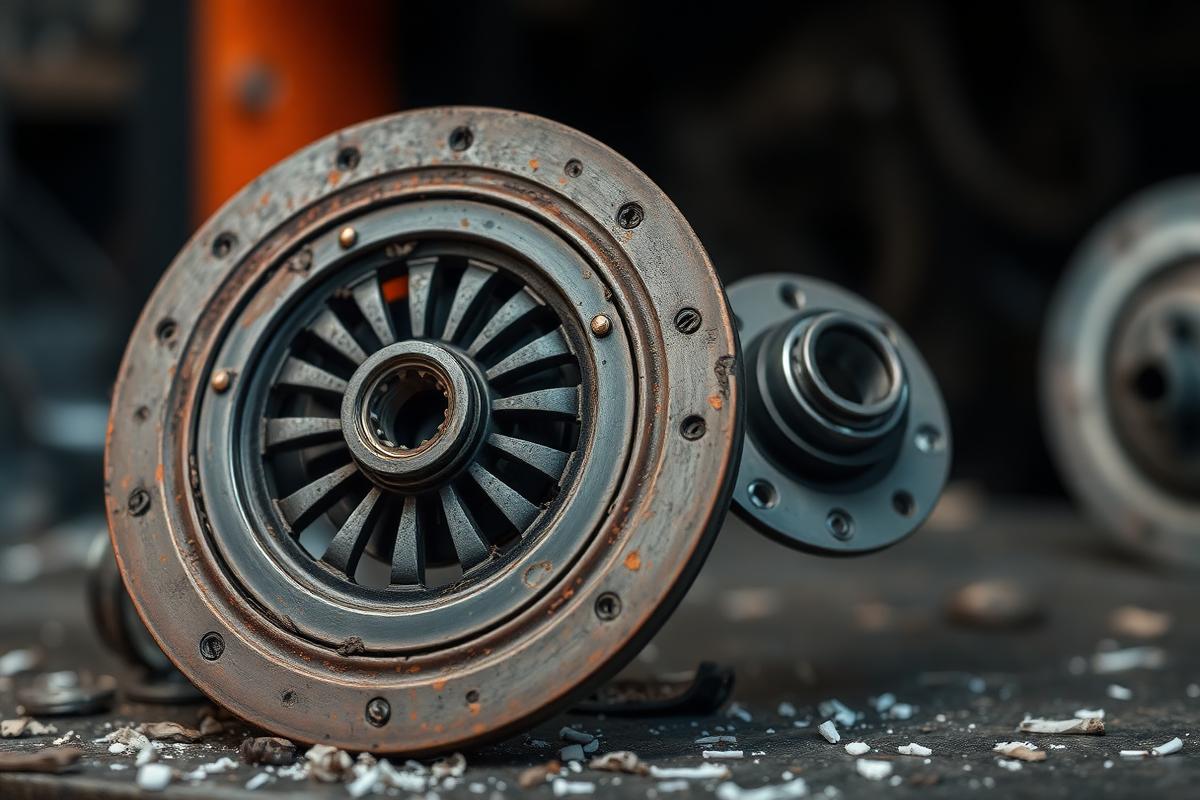
A failing clutch rarely picks a convenient moment. One week the biting point feels a little higher, the next you're on the M60 slip road watching the rev counter climb while the car doesn't. It's one of the more expensive repairs a car will need, and it's also one of the easiest to get wrong — which is why it's worth taking it to a workshop that does nothing else.
Manchester Clutch Specialist replaces clutches on every make and model, from a Corsa that's done 90,000 city miles to a long-wheelbase Transit that earns its keep. Every job starts with a road test and a fixed written quote, and every removed part is kept so you can see exactly what came off your car.
Signs your clutch needs replacing
Clutches almost never fail without warning. The symptoms build over weeks or months, and recognising them early is the difference between a straightforward clutch replacement and a much larger bill.
- Slipping under load. Engine revs rise but road speed doesn't, usually noticed first in fourth, fifth or sixth gear, or when pulling away uphill or with a full car.
- A high or vague biting point. The pedal engages right at the top of its travel, or the point where it bites feels inconsistent.
- Judder pulling away. A shudder through the car as the clutch takes up, often worse when cold or on an incline.
- A burning smell. The distinctive hot-friction smell after hill starts or heavy traffic means the plate is slipping and heating up.
- Noise on the pedal. Rumbling or squealing that changes as you press or release the pedal usually points at the release bearing.
- Difficulty selecting gears. Particularly reverse or first from stationary, which suggests the clutch isn't fully disengaging.
If you're seeing some of these but aren't sure how serious it is, our clutch slipping and symptoms guide goes through each one in more detail and explains what usually causes it.
What a clutch replacement actually involves
The clutch sits between the engine and the gearbox, so getting to it means separating the two. On most front-wheel-drive cars that means removing the battery tray, air box, driveshafts and various brackets, supporting the engine, then withdrawing the gearbox far enough to clear the input shaft. On some vehicles the subframe drops; on a handful, the engine and gearbox come out as a unit.
That labour is the bulk of the cost, which is why cutting corners on parts makes no sense. A standard replacement includes a new friction plate, pressure plate and release bearing — a three-piece kit. We also replace the concentric slave cylinder where the vehicle has one, because it lives inside the bellhousing and replacing it later means paying for the same strip-down twice.
What we check while we're in there
- Flywheel condition, thickness, rock and free travel against manufacturer limits
- Rear crankshaft seal and gearbox input shaft seal for oil contamination
- Input shaft splines — cleaned and correctly lubricated on reassembly
- Spigot bearing, release fork, pivot and clutch cable or hydraulics
- Engine and gearbox mounts, which cause judder that mimics a clutch fault
- Gearbox oil level and condition, topped or replaced as needed
Oil contamination is the one that catches people out. If a rear main seal has been weeping onto the friction plate, fitting a new clutch without replacing that seal guarantees a repeat failure — and a second bill for the same labour. We check for it every time.
The flywheel question
Most diesels and many modern petrol cars use a dual mass flywheel, which contains springs and a bearing to smooth out engine pulses. It's a wearing item with a finite life, and it very often reaches the end of that life at around the same mileage as the clutch.
Some garages replace the DMF automatically on every job, because it's easier than checking and it protects them from comebacks. Others refit whatever's there to keep the quote low, then blame the customer when it rattles six months later. We measure it. If the readings are inside the manufacturer's tolerances, it goes back on and you keep your money. If it's out of spec, we show you the numbers. Read more about dual mass flywheel replacement.
Parts we fit
We use OE or OE-equivalent clutch kits as standard — LuK, Sachs, Valeo and Exedy, depending on what your vehicle left the factory with. We don't offer budget pattern kits. On a repair where the labour is the expensive part, saving eighty pounds on a component that then lasts half as long isn't a saving.
Where a vehicle has a documented weakness, or where it tows, carries weight or has been remapped, we'll talk through uprated options and be honest about the compromises. An uprated clutch usually means a heavier pedal; a solid flywheel conversion means more noise and vibration at idle. Sometimes that's the right call, often it isn't.
Costs and turnaround
Most cars fall between £450 and £850 fitted, with the variation driven almost entirely by how long it takes to get the gearbox out. Vans, four-wheel-drive vehicles and jobs needing a new dual mass flywheel sit above that. You'll have a fixed figure covering parts, labour and VAT before you commit, and that figure doesn't change unless we find something genuinely unexpected — in which case we stop and ring you.
The majority of clutch replacements are booked in for a single day. Drop the car off in the morning, collect it that evening. Where a job needs longer we'll say so upfront, and courtesy vehicles are available on request.
Clutch replacement across Greater Manchester
Our workshop is in east Manchester with easy access from the city centre, the M60 and the A57. We regularly replace clutches for drivers in Manchester, Salford, Oldham, Stockport, Trafford, Tameside, Rochdale, Bury, Bolton and across the wider North West, and collection and delivery within about fifteen miles can usually be arranged.
If the fault turns out to sit further back than the clutch, we handle that too — manual gearbox assessment and replacement and automatic transmission replacement are both done in house. Get in touch for a free quote and we'll give you a straight answer.