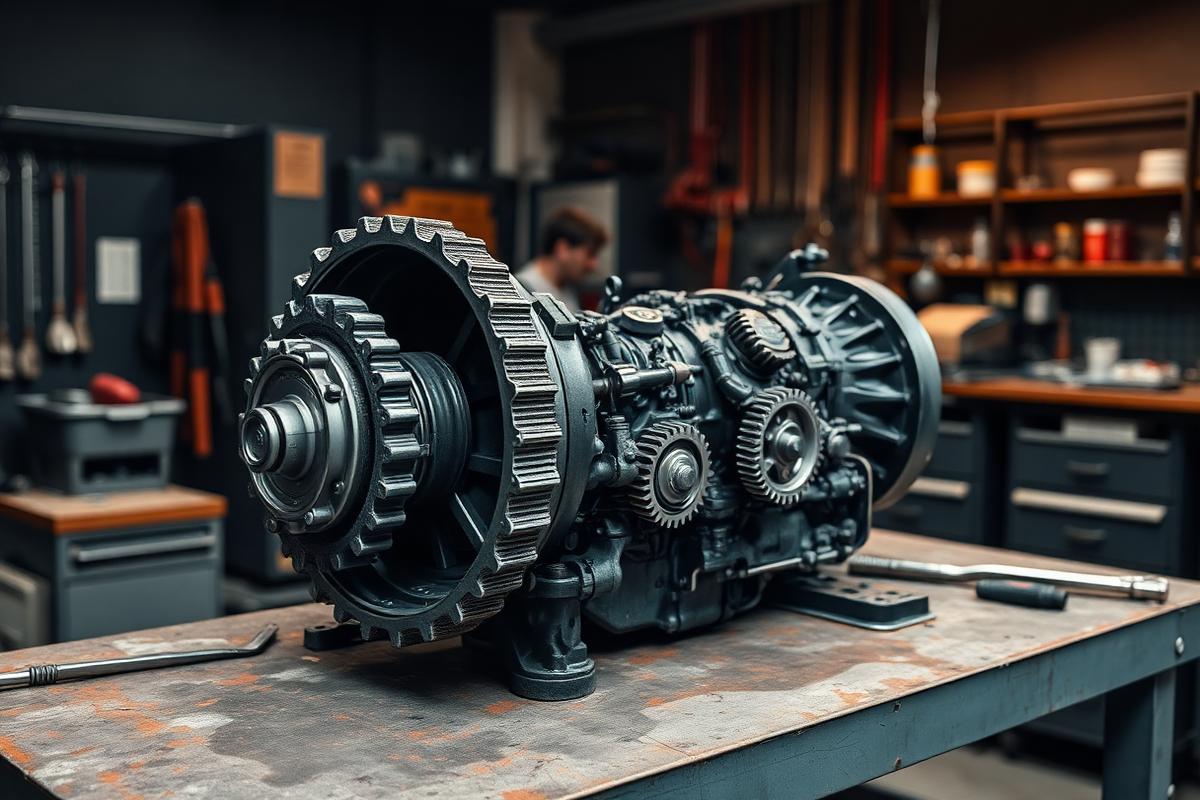
A whining gearbox tends to announce itself gradually. It might start as a faint hum only noticeable on a quiet motorway, then become audible in traffic, then eventually impossible to ignore. Because the sound is easy to confuse with a wheel bearing or tyre noise, plenty of drivers live with it for months before finding out what it actually is.
The characteristic that separates gearbox whine from most other road noise is that it tracks road speed rather than engine revs, and it often changes or disappears in neutral, which points squarely at something rotating inside the transmission itself.
What causes gearbox whine
- A worn input, output or layshaft bearing. The most common cause. As a bearing wears, the shaft it supports develops play, and that play produces a whine that gets louder as the bearing deteriorates.
- Low or degraded gearbox oil. Gear oil lubricates and cushions the contact between gear teeth. When the level is low or the oil has broken down, metal runs closer to metal than it should, producing noise well before serious damage appears — an easy win if caught early.
- Worn gear teeth. High-mileage gears develop wear patterns that change how smoothly they mesh, producing a whine that is often specific to one gear.
- A worn differential or final drive. On front-wheel-drive cars the differential lives inside the gearbox casing. Wear here often produces a whine that changes noticeably between accelerating and coasting.
Is it safe to drive?
A whine on its own, particularly a mild one that only appears at certain speeds, does not mean immediate failure, and many cars are driven for a while with a known bearing whine. But bearing wear is progressive rather than static. Left unaddressed, a worn bearing can eventually break up, and debris from a disintegrating bearing can damage the shaft, gears or casing around it, turning an isolated repair into a full replacement.
If the whine is getting noticeably louder over a matter of weeks, or is joined by a change in note, a grinding edge, or difficulty selecting gears, that is a sign the wear has progressed and it is worth booking an inspection promptly rather than waiting for it to fail completely.
How we diagnose it
We start with a road test to establish exactly when the noise appears — under acceleration, on a trailing throttle, in specific gears, or constantly regardless of gear. That pattern alone tells us a great deal. We then check gearbox oil level and condition, since this is the cheapest possible cause to rule out, before assessing further.
Our approach on manual and gearbox faults generally is to diagnose first rather than assume the worst. Full detail on how we assess a gearbox, and when we recommend repair over replacement, is covered on our gearbox repair and replacement page.
What decides repair versus replacement
- Whether the wear is contained to a single identifiable bearing or gear
- Whether metal debris from a worn component has contaminated the rest of the gearbox
- The age and overall condition of the gearbox and how many miles it has left in it
- Whether parts for a partial repair are realistically available for your vehicle
- Cost of a contained repair versus the cost and reliability of a replacement unit
Where wear is genuinely contained to one bearing and caught early, opening the box and replacing that bearing can be the more economical route. Where wear has spread, or the gearbox is old enough that other components are close behind it, a replacement gearbox is usually the more sensible long-term option, and we will tell you plainly which category your car falls into.
What it costs
Costs vary considerably depending on which bearing or component is involved and how accessible it is. A contained single-bearing repair is generally the cheaper path. A full gearbox replacement is a larger job, priced against your specific vehicle after inspection, and we always give you a fixed figure before any work proceeds rather than an open-ended estimate.
If the whine is accompanied by clutch symptoms such as slipping or a burning smell, it is worth reading our clutch slipping and symptoms guide alongside this page, since the clutch and gearbox are removed together and it is often sensible to address both at once.
Covering Manchester and the surrounding areas
We diagnose and repair gearbox whine for drivers across Manchester, Salford, Oldham, Stockport, Trafford, Tameside, Rochdale, Bury, Bolton and the wider North West, with a free road test and inspection before any quote. If your vehicle turns out to need a full transmission replacement rather than a repair, we also cover automatic transmission replacement for cars fitted with an automatic or DSG gearbox. Get in touch and describe the noise and we will advise on next steps.