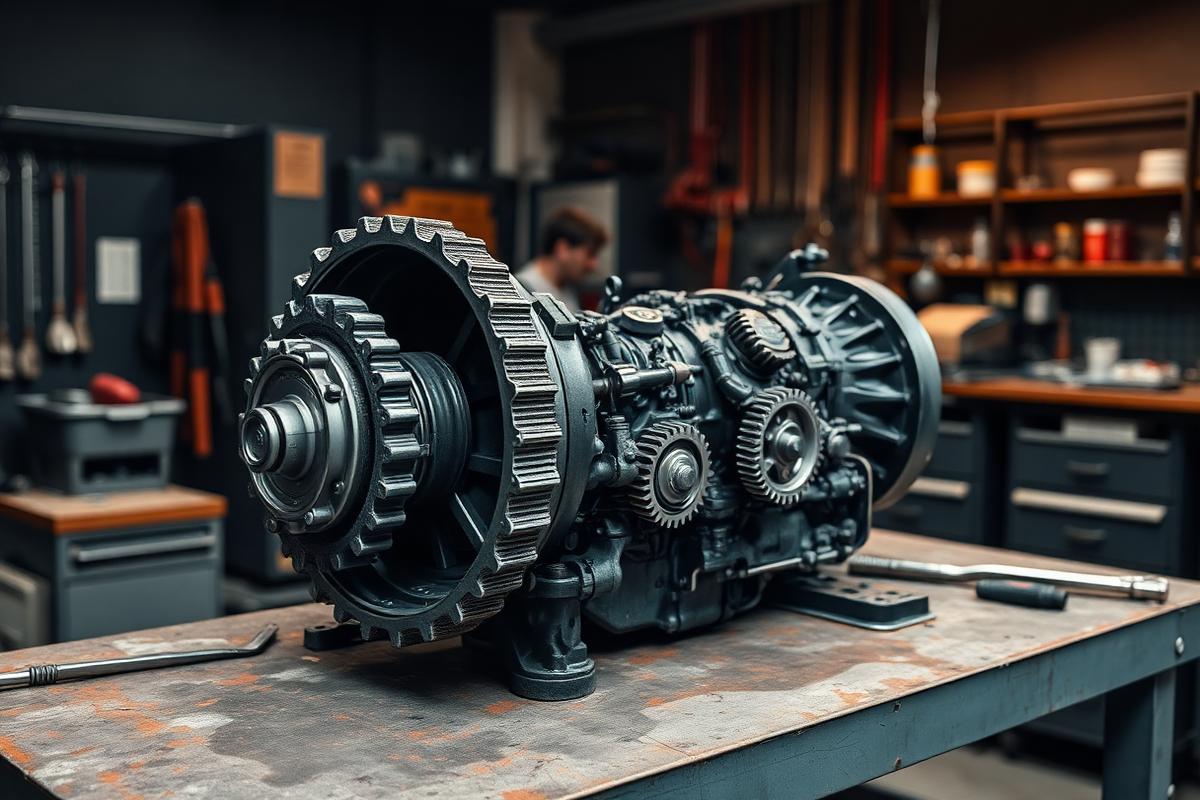
This fault has a distinctive feel. You select a gear, accelerate, and a moment later the lever seems to slip back towards neutral on its own, the engine note flares as drive is lost, and you have to reselect the gear to carry on. It can happen occasionally at first, often in one particular gear, and then more frequently and in more gears as the underlying wear progresses.
It is different from difficulty getting a gear to engage in the first place, which usually points at the clutch not fully disengaging. Jumping out of gear after it has already engaged points at wear inside the gearbox's mechanism for holding a gear selected.
What causes a gearbox to jump out of gear
- Worn selector forks. These forks hold the sliding gear collars in position. As they wear, they lose the precision needed to keep a gear fully engaged under load, and the collar can slide back under the reaction force of the gear teeth.
- Worn synchroniser hubs and dog teeth. The teeth that lock a gear into place can round off over a long service life, reducing how positively the gear stays engaged.
- Weak or worn detent springs and balls. A small spring-loaded mechanism holds the selector rail in each gear position. A weakened spring lets the rail move more easily than it should, particularly under the vibration and load of acceleration.
- Worn or perished engine and gearbox mounts. Excess movement under acceleration can momentarily misalign the linkage between the gear lever and the gearbox, popping the lever out even when the internal mechanism is otherwise sound.
- General gearbox wear and end float. On higher-mileage boxes, wear in shaft bearings can allow small amounts of axial movement that make it easier for a gear to walk out of engagement.
Why it matters, not just an inconvenience
Losing drive unexpectedly is more than an annoyance. If it happens while overtaking, on a motorway slip road, or under load on a hill, the sudden loss of drive and the engine flaring can be genuinely dangerous, both to you and to other road users reacting to your car's sudden change in speed. It also tends to worsen the more the gear is forced back in under load, since each repeated pop-out further wears the mechanism holding it.
If your gearbox is jumping out of gear, particularly in higher gears at speed, we would treat this as a fault to get looked at promptly rather than something to live with.
How we diagnose it
We start by establishing which gear or gears are affected, whether it happens under acceleration, deceleration, or both, and whether there is any related noise or vibration. A fault confined to one gear points at wear local to that gear's fork or synchroniser. A fault affecting several gears, or worsening generally, points at wider wear inside the box, or occasionally at mounts rather than the gearbox itself — which we check first, since it is the cheaper possibility to rule out.
From there, the gearbox is inspected internally to establish exactly where the wear is and how far it has progressed. Full detail on our approach to gearbox assessment, including when we repair rather than replace, is on our gearbox repair and replacement page.
Repair or replacement
- Wear confined to one selector fork or detent mechanism can sometimes be repaired directly
- Wear spread across multiple gears usually points to a wider service life issue
- Metal debris from worn components circulating in the gearbox oil affects other parts
- Overall condition and remaining life of the gearbox against the cost of a repair
We diagnose first and repair where a contained fix is genuinely reliable. Where the wear is more widespread, or the gearbox is old enough that further failures are likely soon after, a replacement gearbox is usually the more sensible long-term choice, and we explain exactly why before recommending it.
What it costs
Because reaching the internals of a manual gearbox generally means removing it from the car regardless of which specific component has failed, the labour involved is similar whether the eventual fix is a contained repair or a full replacement. A targeted repair to a single fork or detent mechanism is typically the cheaper outcome; a full replacement is priced against your specific vehicle once we know its condition. We confirm the fixed cost after inspection, not before.
If the fault coincides with clutch symptoms, our clutch slipping and symptoms guide is worth reading too, since both are accessed via the same removal process.
Covering Manchester and the surrounding areas
We diagnose and repair gearboxes that jump out of gear for drivers across Manchester, Salford, Oldham, Stockport, Trafford, Tameside, Rochdale, Bury, Bolton and the wider North West. For automatic and DSG gearboxes that slip or hesitate rather than physically pop out of gear, see our page on automatic transmission replacement. Get in touch and tell us which gear is affected and we will advise on next steps.